
(Editor’s Note: Since 2023, Ukraine now follows the western tradition of celebrating Christmas on December 25th, although some individual churches may still observe the holiday according to the Julian calendar.)
UKRAINIAN HOLIDAY TRADITIONS
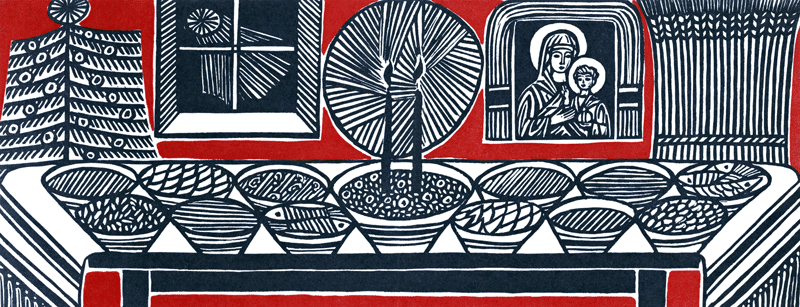
In former times, on Christmas Eve the head of a Ukrainian household would go out to the barn to give food to the cattle and greet them on the holiday. Then he would bring a sheaf of grain and some hay into the house. He would set up the sheaf, a symbol of the ancestors, in the place of honor under the icons. He would strew the hay on the floor. He would also spread some hay onto the dining table, and his wife would place a tablecloth over the hay. When the first star appeared in the evening sky, the family and any guests would gather at the table. The father would recite a prayer and say a few words about the holiday. He would then give a piece of bread dipped in honey to each family member and guest, exchanging kisses with each. Before sitting down, they would sing a solemn Christmas song. An extra place at the table would be reserved for any unexpected guest who might be passing by.
The supper consisted of twelve courses, in honor of the twelve Apostles. Because Christmas Eve falls on the last day of the Advent fast, however, there would be no meat or dairy. Typical Christmas Eve dishes included borshch, fish (often trout, carp, or salmon), herring, mushrooms, beans, potatoes, dumplings, knishes, sauerkraut, stuffed cabbage, buckwheat, braided bread, and fruit compote.
The most characteristic Christmas Eve dish, however, is kutia, a kind of pudding made from boiled shelled wheat, poppy seeds, and honey, often with walnuts and raisins. This ancient dish is connected with the ancestor cult and belief in eternal life. In some areas, a spoonful would be thrown up onto the thatched ceiling; if it stuck, it meant that honey would be plentiful in the new year. After the meal, a dish of kutia would be left at the window for the spirits of the departed. Food was also taken to the priest, close relatives, godfathers and godmothers, the local midwife, and others.
Traditional Ukrainian Christmas customs and rituals, which have pre-Christian roots, varied from region to region and even village to village. Between 1918 and 1991, however, the Soviet regime opposed religion as well as reverence for the natural and spiritual world. This, along with russification, erased much of Ukraine’s Christmas and other holiday traditions. Urban traditions were practically forgotten in the Sovietized cities; only rural customs survived, mostly in isolated areas like the Carpathian mountains in western Ukraine. The folklore of that region was vividly depicted in Sergei Paradjanov’s renowned film “Shadows of Forgotten Ancestors.”
Today, Ukraine is also home to small but active Jewish and Muslim communities. Their chief holidays, however, usually fall outside the winter season.
Sources:
Ukraine: A Concise Encyclopedia, Vol. I (Toronto, 1963), pp. 321-22
Ol’ha Verbenets’ and Vira Man’ko, Obriady i stravy Sviatoho Vechora, Lviv, 2008.
Photo Credit:
By Jacques Hnizdovsky – Artist’s Estate, CC BY-SA 3.0, https://commons.wikimedia.org/w/index.php?curid=5150134
Andrew and Oksana Sorokowski, Guest Editors
